
Electronics thermal simulation, from package to system
Thermal models of boards, packages and enclosures that are fast enough to search a design space, with a stated envelope for where each one can be trusted.
01The problem
Every cooling decision costs another solve
A fine-mesh conjugate-heat-transfer run of a populated board is accurate and slow. Checking one design that way is fine. Sweeping power maps, fan curves, heatsink options and inlet conditions means hundreds of solves, so most teams test a handful of cases and design around the worst one they happened to pick.
02What we do
Four kinds of thermal model, picked per question
- Conjugate heat transfer
- Coupled solid and fluid thermal simulation of boards, enclosures and airflow paths, set up and run on your solver or on OpenFOAM.
- Compact and reduced-order models
- Boundary-condition-independent compact models of packages and reduced-order models of a full device, small enough to run inside a system model or a controller loop.
- Surrogates for design search
- Models trained on a designed set of simulations that predict component temperatures across power, airflow and inlet conditions fast enough to drive an optimizer.
- Multi-fidelity fusion
- Many coarse-mesh runs corrected by a few fine-mesh runs with co-Kriging, so the whole operating envelope is covered without paying for a fine mesh at every point.
03Evidence
What we have run and published
A 1U server board, 200 coarse-mesh and 10 fine-mesh conjugate-heat-transfer runs, fused with co-Kriging. Leave-2-out cross-validated error on component temperatures fell by 62–67% against the raw coarse mesh.
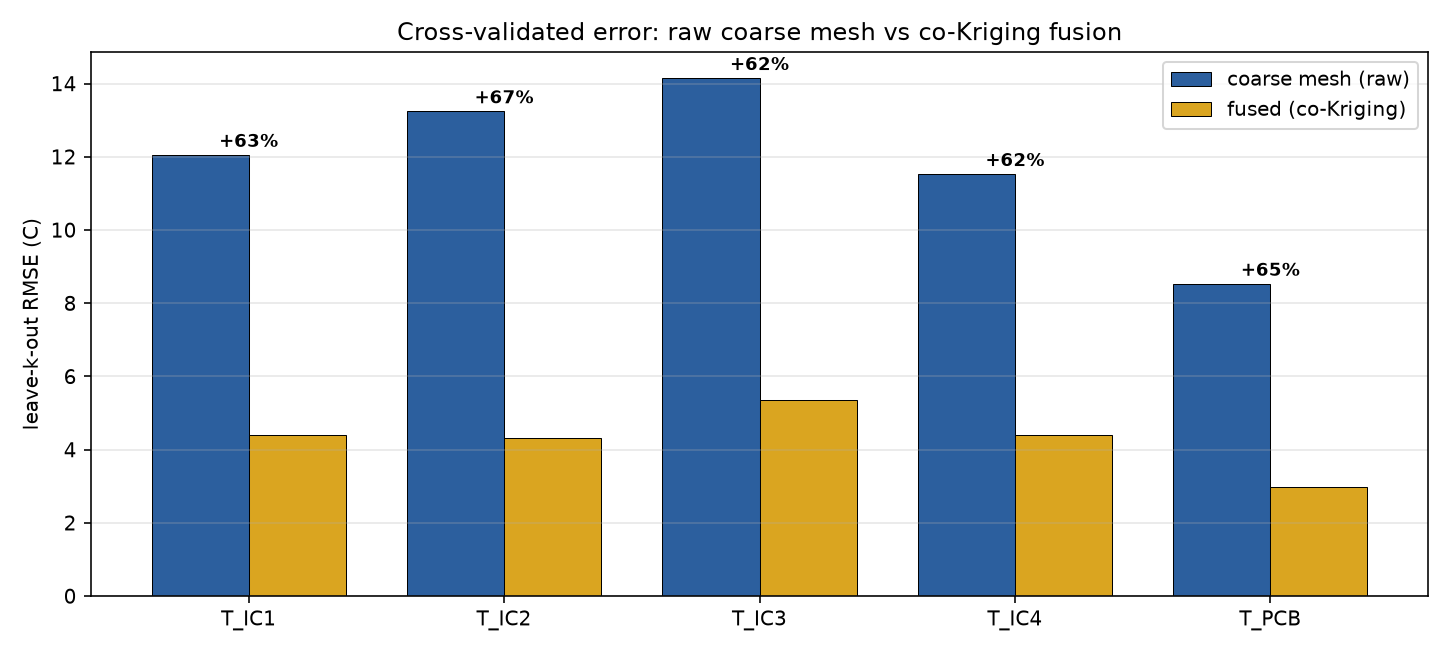
| Output (volume-avg.) | RMSE coarse °C | RMSE fused °C | Reduction |
|---|---|---|---|
| CPU 1 T_IC1 | 12.05 | 4.40 | −63% |
| CPU 2 T_IC2 | 13.24 | 4.31 | −67% |
| Chip 1 T_IC3 | 14.15 | 5.36 | −62% |
| Chip 2 T_IC4 | 11.53 | 4.41 | −62% |
| PCB T_PCB | 8.53 | 2.99 | −65% |
Seven years building electronics-thermal models at Ansys
Our founder worked on Ansys Icepak at package, board and system level, and is a named inventor on three granted US patents in this area.
- US 10,409,358 B1Multi-chip module package compact thermal models
- US 11,250,195 B2Method and system for ROM based dynamic thermal management analysis and control
- US 11,314,305 B2Dynamic thermal management simulation using improved reduced order modeling
04Your toolchain
Runs on the solvers you already use
AgentCrew drives setup and runs through each tool's scripting layer. Current connector coverage:
- Siemens NX
- Solid Edge
- FreeCAD
- Fluent Meshing
- Ansys Meshing
- snappyHexMesh
- Ansys solver suite
- OpenFOAM
05Limitations
Where these models stop
- 01
Surrogate and multi-fidelity models are trusted inside the envelope they were trained on. Queries outside it are flagged, and a new geometry class or physics regime needs fresh training runs.
- 02
In the published study the fused model was worse than the raw coarse mesh at some individual test points, and its largest errors sit at the corners of the operating envelope where fine-mesh coverage is thinnest.
- 03
The study predicts volume-averaged component temperatures. Peak and junction temperatures need their own outputs and their own validation.
- 04
A fast model shortlists designs. A full high-fidelity solve still signs off the one you build.
Bring a board and the thermal question you need answered. We will tell you which model fits it and what it would take to build.