
- Surrogate models
- Electronics-thermal
- Design-space search
- Interpolation vs extrapolation
- Fast models
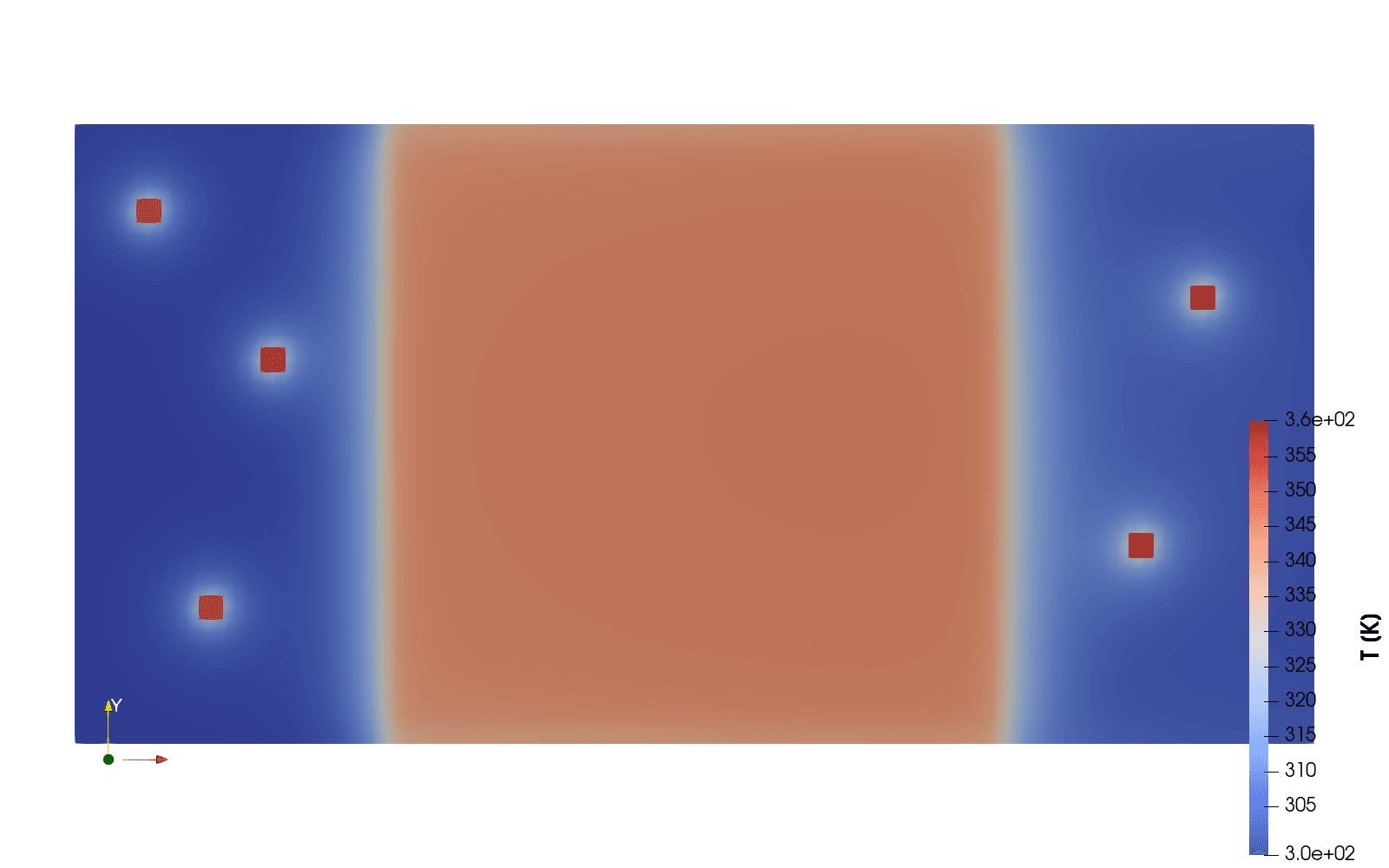
PROBLEM
High-fidelity electronics-thermal simulation is accurate but slow: minutes to hours per configuration. That is fine for verifying one design, but it makes searching a design space (component placement, power maps, heatsink and airflow choices) painfully expensive, because every candidate costs another full solve.
The question is whether a fast model can stand in for the full simulation closely enough to drive that search, and, just as importantly, where it can be believed and where it cannot.
APPROACH
This is the setup our founder spent seven years building at ANSYS: fast-model-plus-optimization for electronics thermal. A surrogate model is trained on a sample of high-fidelity thermal simulations spanning the design variables of interest, then predicts junction and component temperatures in milliseconds instead of hours, fast enough to put an optimizer or a live design-space explorer on top of it.
The discipline is in the framing as much as the model. A surrogate is trustworthy inside the envelope it was trained on, where it interpolates between sampled configurations; ask it to extrapolate beyond that envelope and that trust is gone. We treat the trained region as a first-class part of the deliverable: the model reports when a query sits outside where it has support, so a fast answer is never mistaken for a validated one.
- Train on a designed sample of high-fidelity runs across the target variables.
- Predict junction / component temperatures in milliseconds for design search.
- Trust interpolation within the trained envelope; flag extrapolation beyond it.
- Fall back to a full high-fidelity solve to confirm a shortlisted design.
RESULT
The payoff is a different kind of workflow: a design search that would have taken hours of simulation per candidate becomes an interactive sweep, because each surrogate evaluation is effectively free. The full solver still does what it is good at, confirming the shortlisted designs at high fidelity.
The trade-off is speed against accuracy: milliseconds instead of hours inside the trained envelope, with a full solve reserved for confirmation.
LIMITATIONS
A surrogate is only as good as its training envelope, and pretending otherwise is where fast models go wrong:
- Accuracy holds for interpolation within the trained design space; extrapolation is not reliable.
- A new geometry class, boundary condition, or physics regime generally needs fresh training data.
- The surrogate accelerates search; it does not replace a high-fidelity solve for final sign-off.
- Sampling quality bounds everything: a sparsely-sampled region is a weakly-known region.
Have a study like this to run?
We build agentic CAE/CFD pipelines and surrogate models on your solvers, on your infrastructure, with verification agents gating every stage.