- NSGA-II
- OpenProp / BEMT
- OpenFOAM RANS
- MRF k-ω SST
- Multi-objective
- Agentic pipeline
PROBLEM
Design a propeller for a planing-hull unmanned surface vessel of roughly 200 kg, at a design speed of 15 m/s (about 29 kn) in seawater, delivering a required thrust of 380 N. The problem is multi-objective for real physical reasons: maximize open-water efficiency η₀ while minimizing shaft torque Q. The two pull in opposite directions and set the motor you can select.
The search has to stay inside the physics that actually constrains a small high-speed prop.
- Cavitation margin enforced with a Keller-criterion check.
- Tip-speed limit to keep the blade tips out of the cavitation regime.
- Motor-torque ceiling so the winning design is one you can actually drive.
- Thrust treated as a hard equality constraint (380 N), not a soft target.
APPROACH
The design vector is expressed as genes for a genetic algorithm: blade count Z ∈ {3, 4, 5}, diameter D from 0.12–0.20 m, shaft speed N from 3000–6000 RPM, and three chord-scale genes (root / mid / tip) applied over a DTMB-4119-like baseline blade (a NACA a = 0.8 meanline with a NACA66 thickness form).
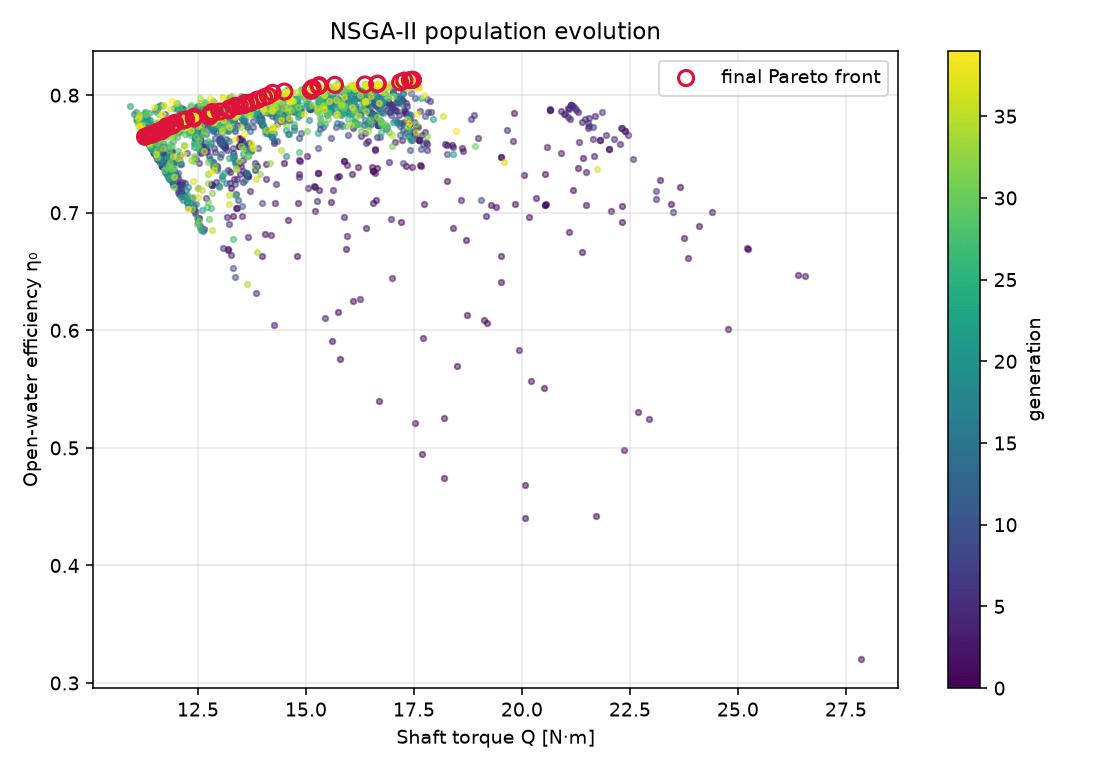
Each candidate is scored fast with OpenProp lifting-line BEMT (the Epps optimizer), which holds thrust as a hard equality constraint. That fast evaluator sits inside a pymoo NSGA-II search (population 64, 40 generations), which produces a Pareto front spanning the motor-selection trade: low-RPM / high-torque / high-η at one end, high-RPM / low-torque / lower-η at the other.
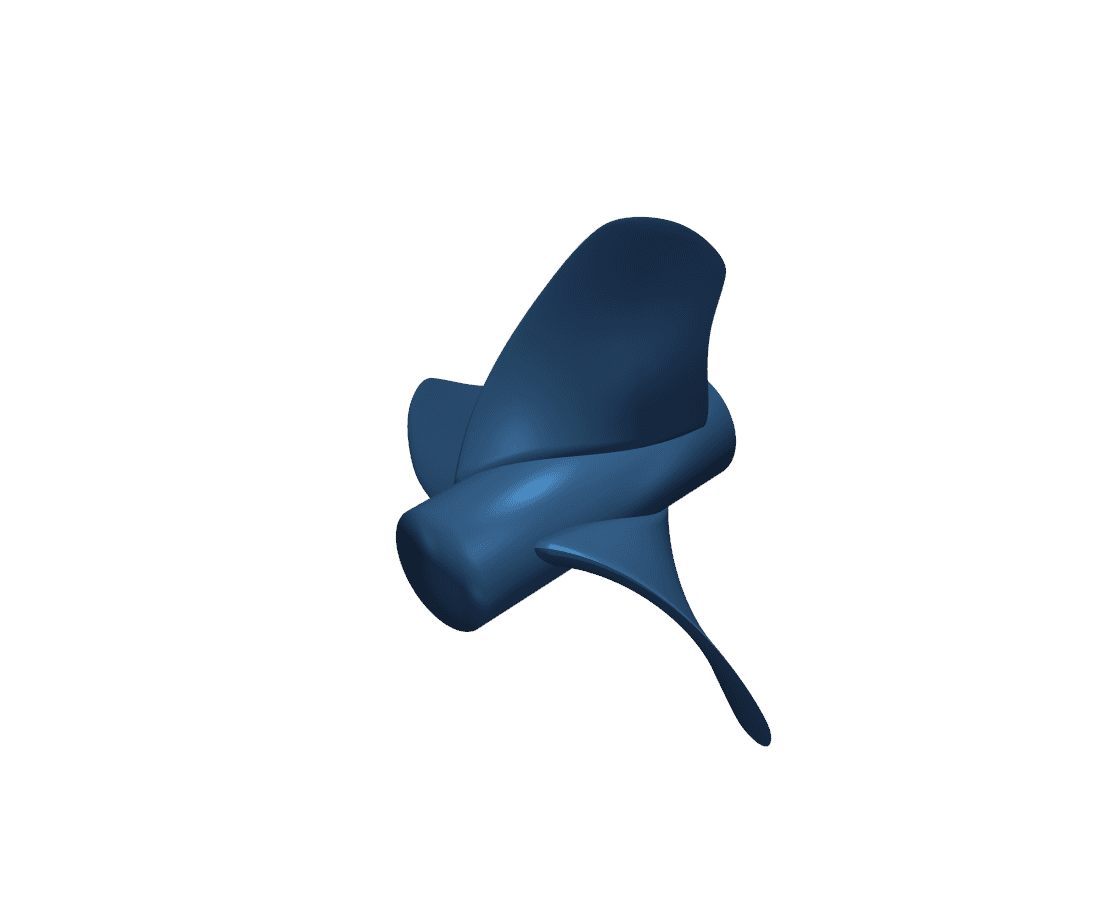
The knee point of that front is lofted to an STL and handed to OpenFOAM v2506 for a blade-resolved RANS verification: snappyHexMesh + simpleFoam, MRF with a k-ω SST turbulence model, run at two operating points (the design advance ratio J and J − 0.15). CFD KT, KQ and η₀ are then compared directly against the BEMT prediction.
The whole sweep → search → verify loop is automated and orchestrated by review agents. Separate agents own geometry review, mesh QA, solver QA, and run monitoring, each with a defined check it has to pass before the pipeline advances.
RESULT
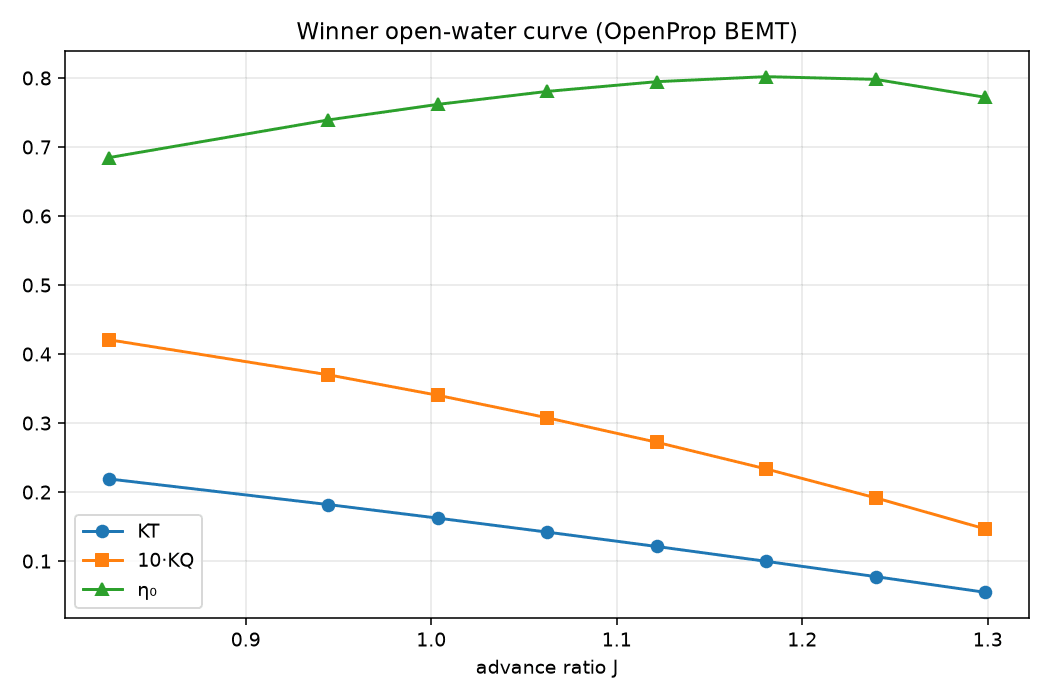
The study produces a verified open-water curve for the winning geometry and a BEMT-vs-CFD agreement table across KT, KQ and η₀ at the two operating points. The two methods agree qualitatively, and the sections below account for where they diverge.
The discrepancies are expected and physical, and naming them is the point:
- Blade-resolved RANS captures viscous and 3-D effects that a lifting-line model approximates.
- Hub drag is resolved in CFD but only lumped in BEMT.
- Tip-vortex resolution depends on the near-tip mesh, which BEMT does not model at all.
LIMITATIONS
- Steady MRF was used (no sliding-mesh URANS), so unsteady blade-passage effects are not resolved.
- No cavitation model in the CFD; cavitation is handled up front as a Keller margin inside the GA constraints.
- Open-water only. No hull or wake effects, and no self-propulsion interaction.
- The comparison is BEMT vs. a single verified geometry; the full Pareto front was not swept in CFD.
Have a study like this to run?
We build agentic CAE/CFD pipelines and surrogate models on your solvers, on your infrastructure, with verification agents gating every stage.