
- Verification agents
- QA loop
- Physical plausibility
- Post-processing
- Automation risk
PROBLEM
Automation makes a simulation pipeline fast, but speed cuts both ways: an error introduced early is now reproduced at machine scale across every run, and a plausible-looking-but-wrong number flows straight into a report without a human ever pausing on it.
It happened in our propeller optimization study: a solver post-processing step carried a sign-convention error on a force/torque quantity. Left unchecked, it would have produced a self-consistent, confidently wrong result.
APPROACH
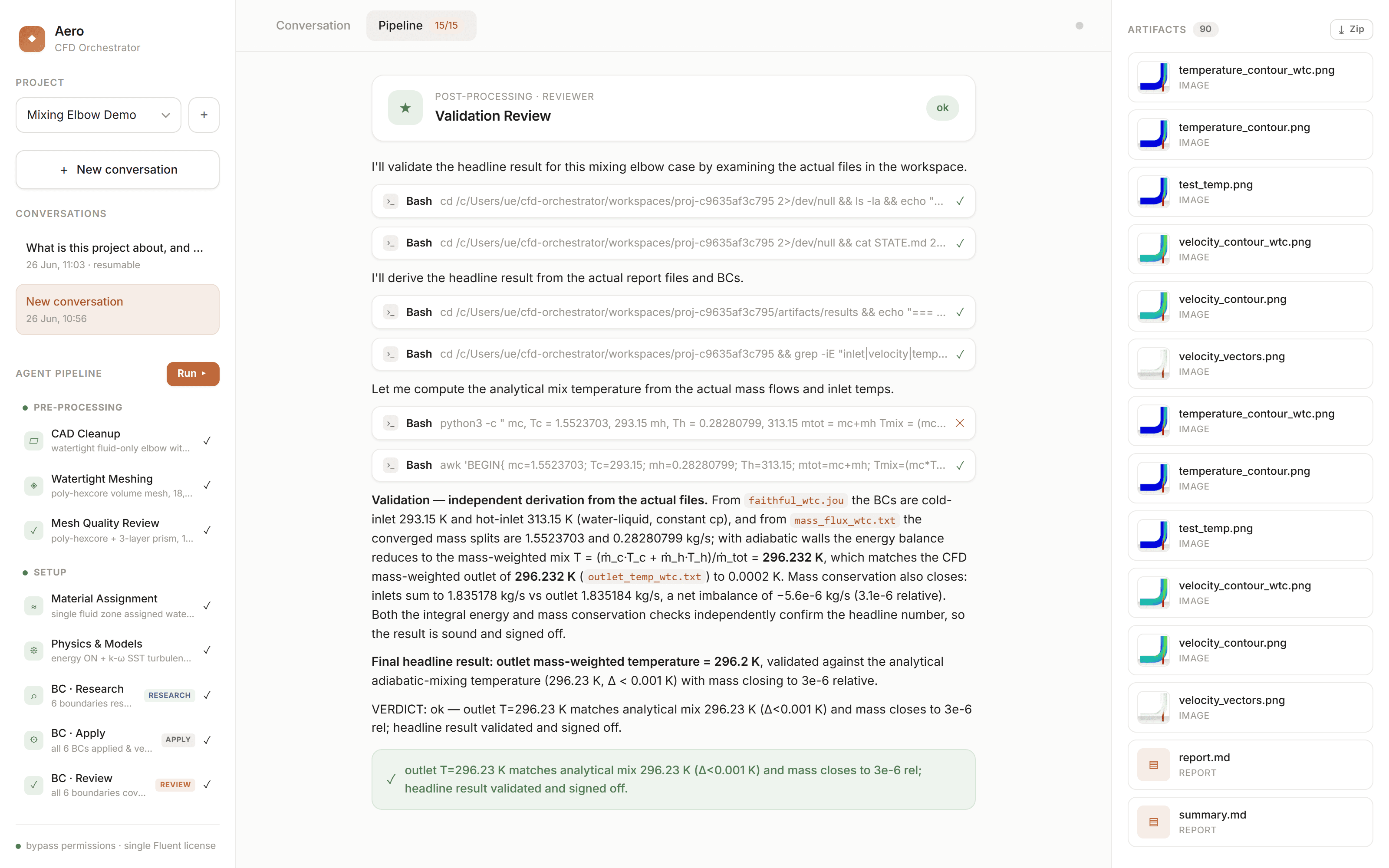
Curlscape's pipelines do not treat automation and verification as the same thing. Alongside the agents that run the study (geometry, mesh, solver, monitoring), a verification agent independently checks each result for physical plausibility: sign, order of magnitude, and consistency with the boundary conditions. It does not assume that the number that came out is the number that was meant.
In this run, the verification step compared the post-processed force/torque against what the physics of the setup required and flagged the inconsistency: the sign was wrong for the configuration. The pipeline stopped there, before the figure was written into the report.
RESULT
The error was caught and corrected at the source instead of shipping. More useful than the fix itself is what it demonstrates. This failure mode is ordinary. That's what makes it dangerous: automation reproduces it silently at scale.
We now design every pipeline around adversarial self-checks: agents whose job is to disbelieve the previous step. Without them, automation only amplifies errors faster.
LIMITATIONS
A plausibility check is a floor, not a proof. It catches results that are physically impossible or inconsistent; it does not certify that a physically-reasonable result is correct.
- Plausibility checks catch gross errors: sign, magnitude, conservation. Subtle modelling errors pass through.
- Verification agents are one layer; validation against experiment or a trusted reference still matters.
- The value scales with how well the expected physics is encoded for each study type.
Have a study like this to run?
We build agentic CAE/CFD pipelines and surrogate models on your solvers, on your infrastructure, with verification agents gating every stage.